

Your Vacancy Pages Are Job Descriptions With a Form Attached

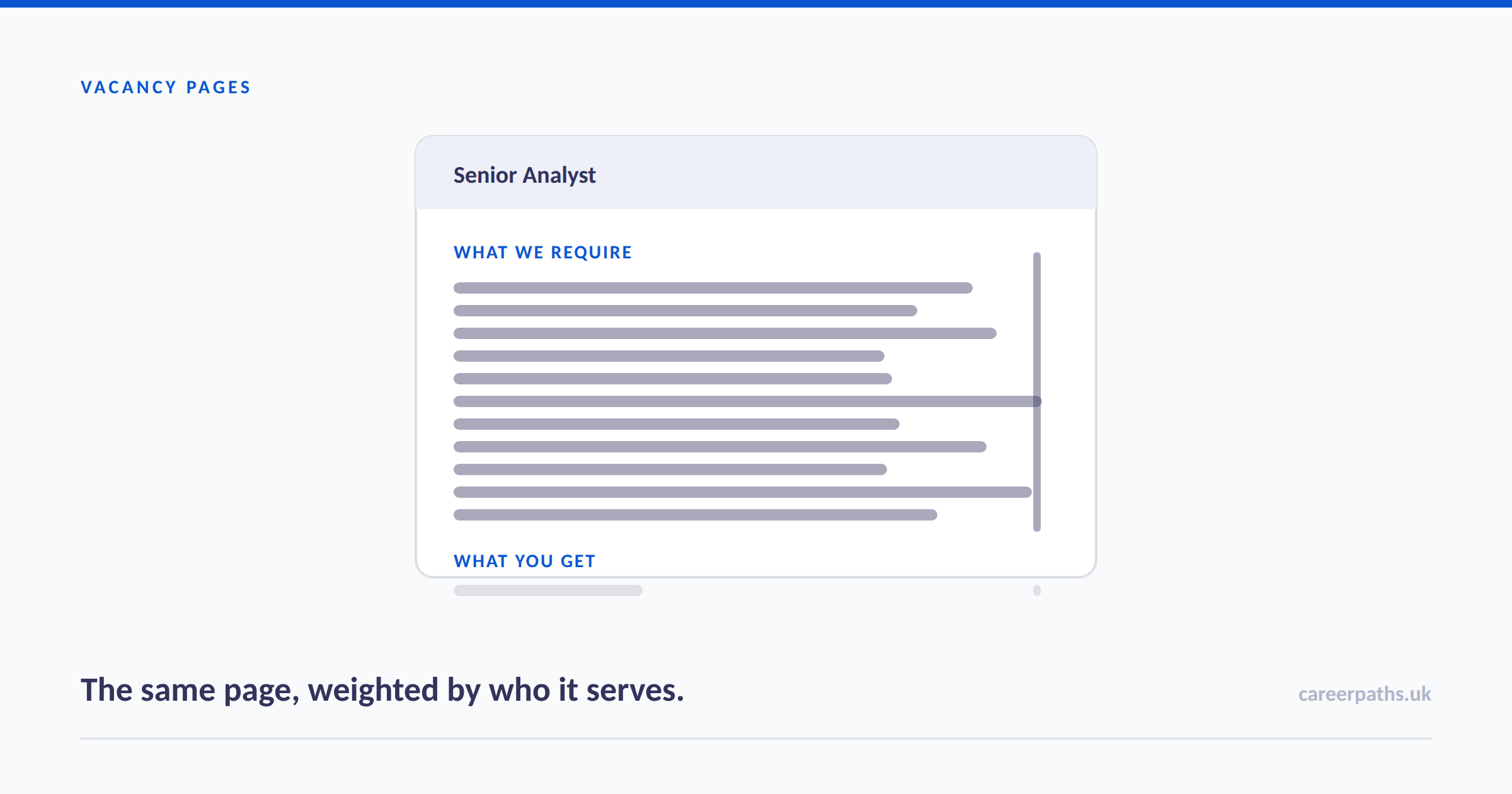
Nobody sat down and decided this. It's what happens when the only document available gets pasted into the only field available, a few hundred times, over several years.
You'll need your careers site open and about twenty minutes. I'd rather you did this than read me describing someone else doing it.
Pick a live vacancy. Ideally one you're struggling to fill.
Now read it the way a candidate would. Not scanning for what you know is there, but properly, top to bottom, as somebody working out whether to give up a Sunday evening to your application form.
Most of what's on screen is a list of things you require. Somewhere there's a paragraph about your organisation that would sit just as comfortably on the site of every competitor you have. Near the bottom, a salary, or no salary. Then a button.
That page is doing something. Advertising isn't it.
---
Where the words on a vacancy page actually come from
Scroll back to the requirements and look at the phrasing rather than the content. If "and any other duties commensurate with the grade" appears anywhere on your page, you can probably guess the rest of this section.
Almost every vacancy page in Britain begins life as a job description, and a job description was written to evaluate and grade. It establishes what the post is accountable for so the post can be sized against other posts, banded, and defended when somebody challenges the banding. Precise. Comprehensive. Difficult to argue with.
For that job, those are the right qualities. In an advert, every one of them works against you. Precision gives you essential and desirable criteria. Comprehensiveness gives you eleven bullet points on stakeholder management. Difficult-to-argue-with gives you the commensurate-with-the-grade line, a sentence that has never once made a human being want a job.
(While you're in there, count the desirables. Half of them are usually on the list because somebody didn't want the grading challenged, and they've been quietly deterring applicants ever since. Anyway.)
Then somebody needed the post filled, opened the ATS, and the only text that existed anywhere in the organisation was the job description. In it went. The next vacancy had a template to follow, and so did the ninety after that.
---
Three questions, marked honestly
Keep the page open. A candidate reading it is trying to answer three things, and you can check each one in under a minute.
"What would I actually be doing?" Not the accountabilities. The work. The first hour of a Tuesday.
"Who would I be doing it with?" A team, a manager, a way of working. People take jobs because of people.
"What happens after this?" Where the role leads, and how they'd know.
Mark your page against each: answered, half-answered, absent. Three absents is the usual score, and it isn't because whoever wrote the page was careless. The document those words came from had no reason to contain any of it. Nobody grades a post on where it leads.
---
The delete-your-company-name test
Ninety seconds, this one, and it's uncomfortable enough to be worth doing properly.
Paste the page text into a blank document. Find and replace your organisation's name with nothing. Take out the logo, the office address, any location detail that's specifically yours, and the boilerplate about heritage and inclusion as well.
Read what's left. Then answer one question: could this be any employer in our sector?
It usually could. Which means nothing on that page is doing the work of making somebody want you rather than the identical role at the organisation twenty minutes down the road. You're competing on salary and commute, because you've given them nothing else to compete on.
What I like about this test is that it doesn't care whether the page is well written. Plenty of them are. It only asks whether the page is yours.
---
Why a careers website redesign won't fix this
Somewhere around here, most organisations commission a careers site refresh. New template, better photography, a video, a cleaner application flow. It feels like the obvious response, and I've watched it happen more times than I can count.
Six months later applications are roughly where they were and nobody can work out why.
The reason is that the new site presents the same job description more attractively. Your three questions are still unanswered, because the source document doesn't contain those answers and never did, and the redesign never went near the pipeline that produces the text. You can make an unanswered question look considerably nicer. It stays unanswered.
A design brief will not fix a content supply problem.
That's an unpopular sentence, particularly if the redesign was signed off last quarter and you were the one who signed it. It's still cheaper to find out now.
Change one page, not all of them
Don't touch the whole site. Pick the role that hurts most: the one you're permanently recruiting for, the one where the agency fee has become an annual event in the budget.
For that role, write three short sections and put them above the requirements.
What you'd actually do. Written by somebody who does the job, not by somebody who manages it. Three or four sentences, concrete. "You'd own the reporting pack that goes to the board every month" beats "responsible for management information" by a distance.
Who you'd work with. The size and shape of the team. Who you'd report to and what they're like to work for. If there's something distinctive about how the team works, say it, including the parts that won't suit everyone. The unflattering detail is what makes the flattering ones believable.
Where it leads. The roles people move into from here, and roughly what it takes. Hardly anybody includes this. It's also the section that survives the delete-your-name test, which isn't a coincidence.
The requirements can stay exactly as they are, further down the page. You're not deleting the job description. You're stopping it from being the whole page.
---
Two things this won't do for you
If a role genuinely leads nowhere, don't write that it does. Some roles are terminal in the structure you currently have. A better-written page brings you more applicants for a job that will disappoint them, and you'll pay for that in nine months when they resign. Fix the route, not the copy.
And it won't beat a pay problem. If you're materially below market, a candidate who now understands the job clearly will understand more clearly why they're going elsewhere. Better information doesn't outrank money. It outranks the *absence* of information, which is what you're currently competing with, and that's a lower bar than it sounds.
What the work does buy you is the candidates who would have chosen you if they'd known what they were choosing.
---
Eighteen months from now
One last thing before you close the tab, because it's the reason this problem comes back even when somebody does the work properly.
The three sections you're about to write will live on a page. Then the role gets advertised again. New hiring manager, new requisition, and somebody opens the ATS, reaches for the only document the organisation actually holds about that job, and pastes it in. Your good writing was held nowhere. That isn't carelessness. The job description is the thing the system keeps.
The version of this fix that survives is the one where the role itself carries the information: what it involves, what it needs, where it leads. Then the advert is generated from something durable, rather than retyped from whatever document is nearest to hand.
That's a different kind of change, and it isn't a copywriting exercise. It's also the difference between fixing a vacancy page and fixing your vacancy pages.
---
The Careers Website Audit Checklist walks your site in candidate order — eight stops, about thirty minutes, with your site open in one tab. It produces a written list of specific findings you can hand to whoever owns the site. Free, no sales call.*
In CareerPaths, one place holds your roles, your framework and your jobs — and we build your careers site from it, so a role page carries what the role involves and where it leads, rather than starting again from a document written to grade it.