

CareerPaths and Your HR System: Better Together
Your HR system stays the master. CareerPaths adds the careers layer it was never built to hold — and it starts without an integration project in front of it.
Running one of these? Good — it stays exactly where it is.
We don't connect to any of them (yet). This page explains why that turns out not to matter.




The short version
Most organisations we talk to have already made the investment. The HR system is in, it holds the employee record, it runs payroll and absence and workflow, and it does that job well.
What it doesn't do — because it was never asked to — is show a person what their future here could look like.
That's a different kind of information. Not "who reports to whom" but "what would I need to be able to do to get there, and who has already made that move". It lives in job descriptions, in framework documents, in the heads of a few long-serving managers, and in almost no organisation does it live anywhere an employee can find it on a Tuesday afternoon when they're wondering whether to stay.
That's the layer we build. Your HR system keeps doing what it's good at.
A clean division of labour
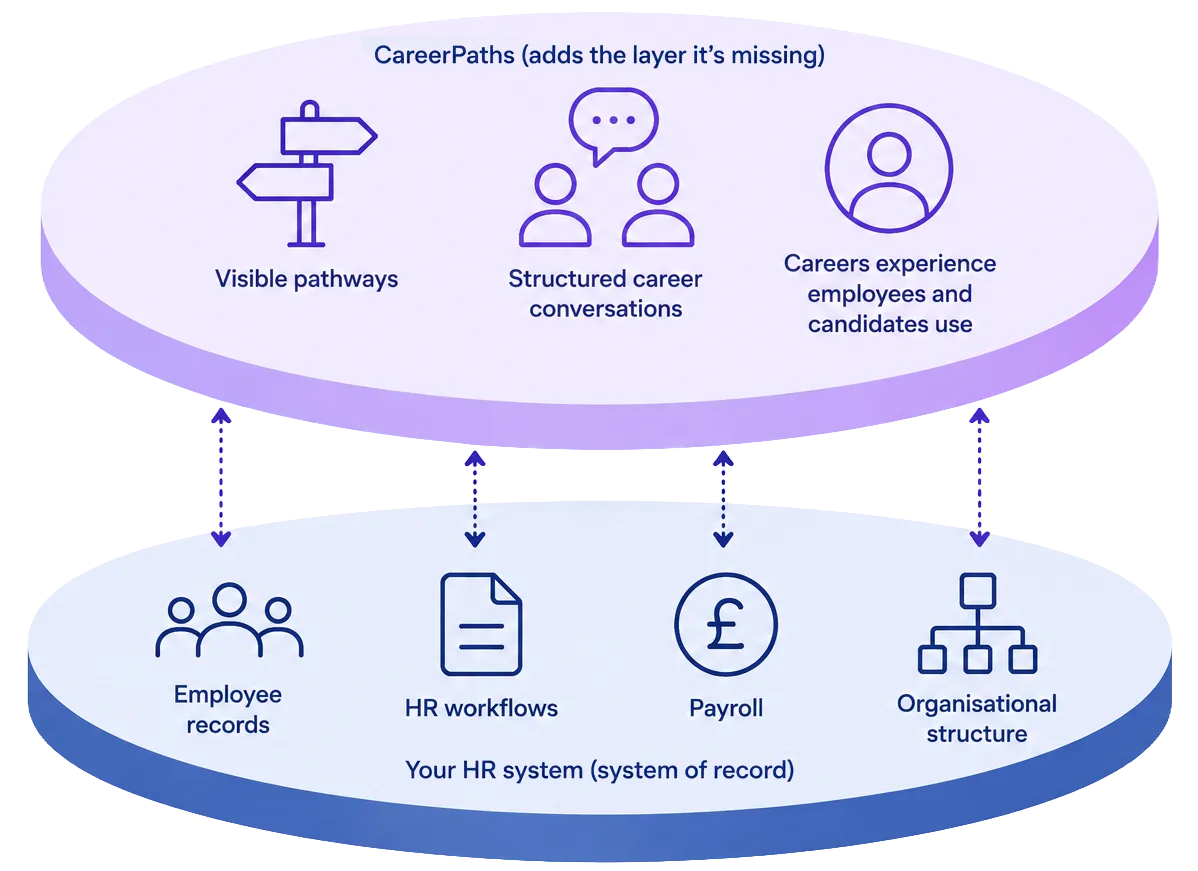
Your HR system: The system of record. Employee data, payroll, absence, HR workflow.
CareerPaths: The careers architecture. Roles, job families, skills and competencies with levels, qualifications and learning, the pathways between roles, and the conversations that move people along them.
Nothing is duplicated as a source of truth. Where data comes from you, it comes across at setup, and your system stays the one that's right.
This is the part people don't expect: because the two systems own different things, they don't need to be wired together to work together. That turns out to be an advantage, and it shows up in how quickly you can start.
What you get

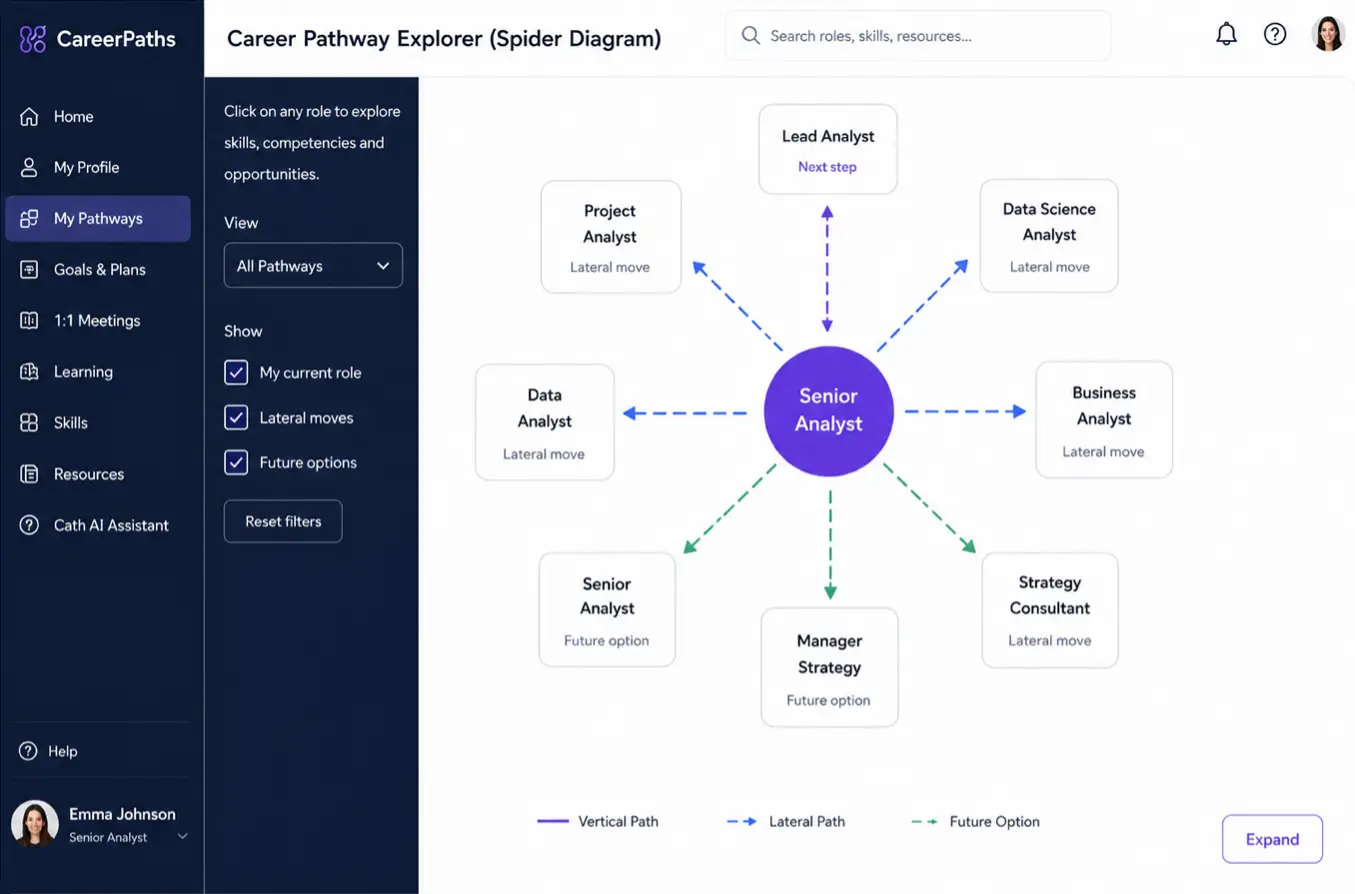
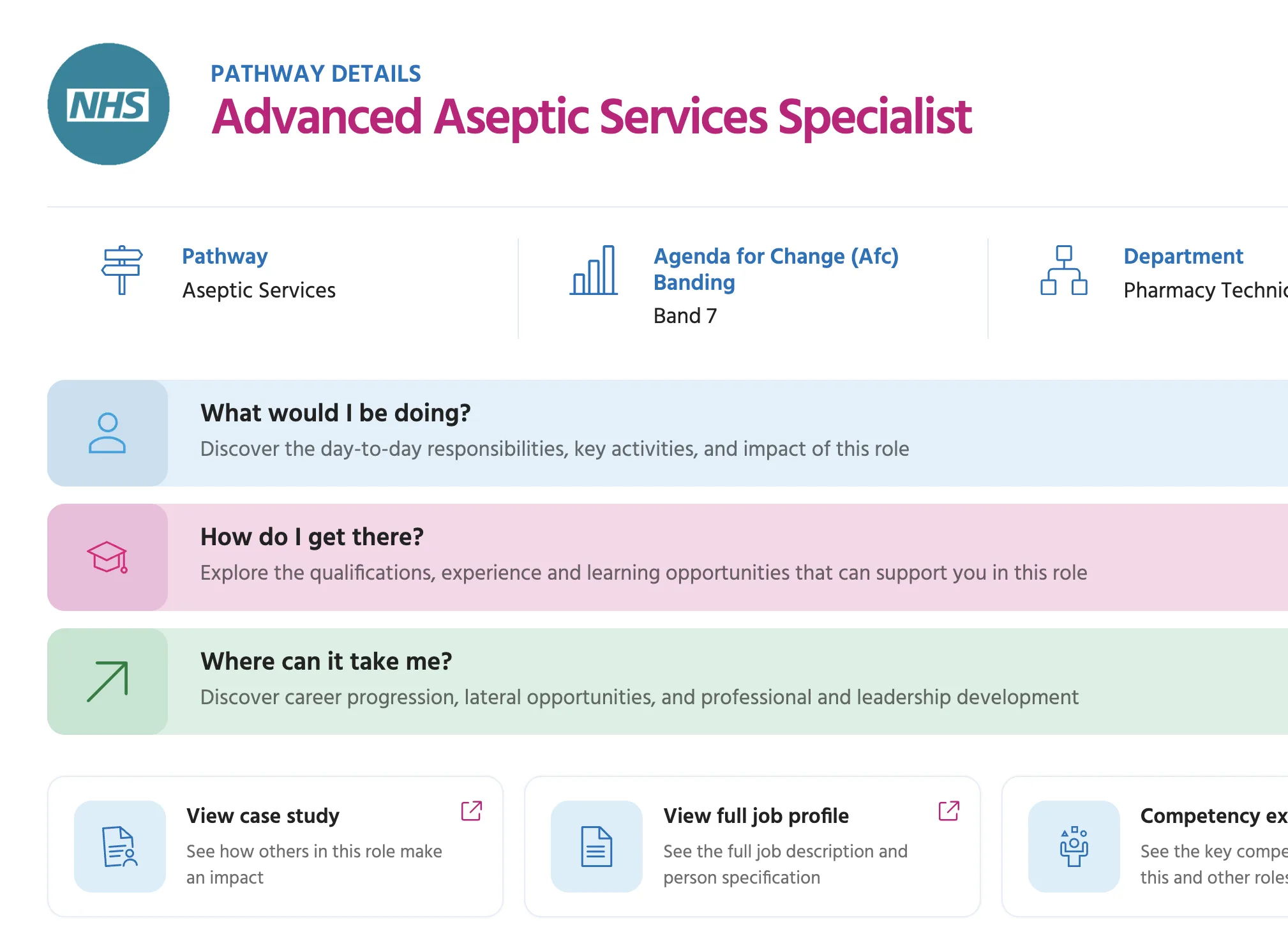
Pathways
Every role, and the routes between them, laid out so people can explore for themselves. What the role needs, what sits between here and there, who else has taken that route.

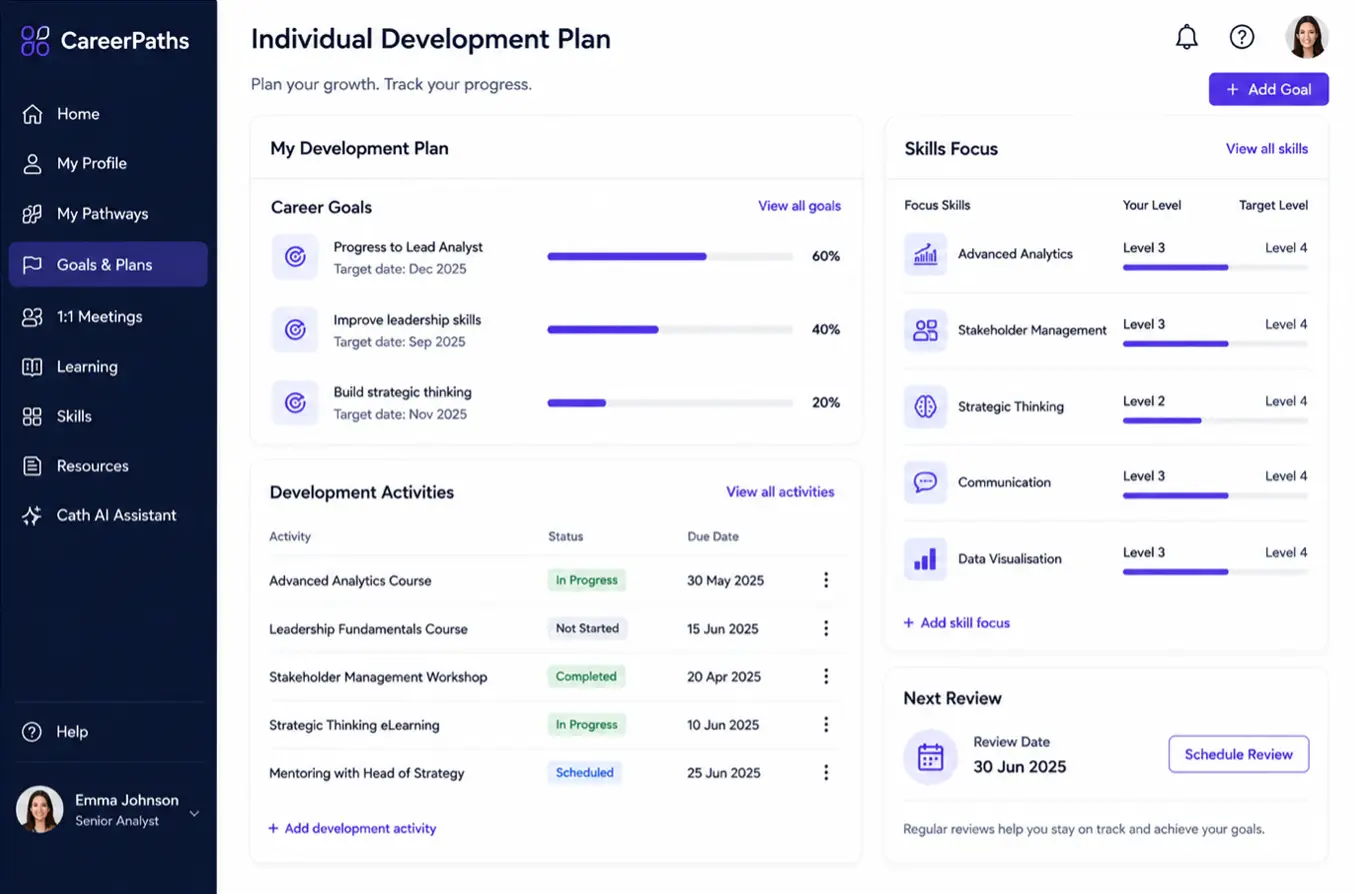
Structured 1:1s with the role and pathway data in the conversation itself — so "I'll find out" becomes "let's look now".

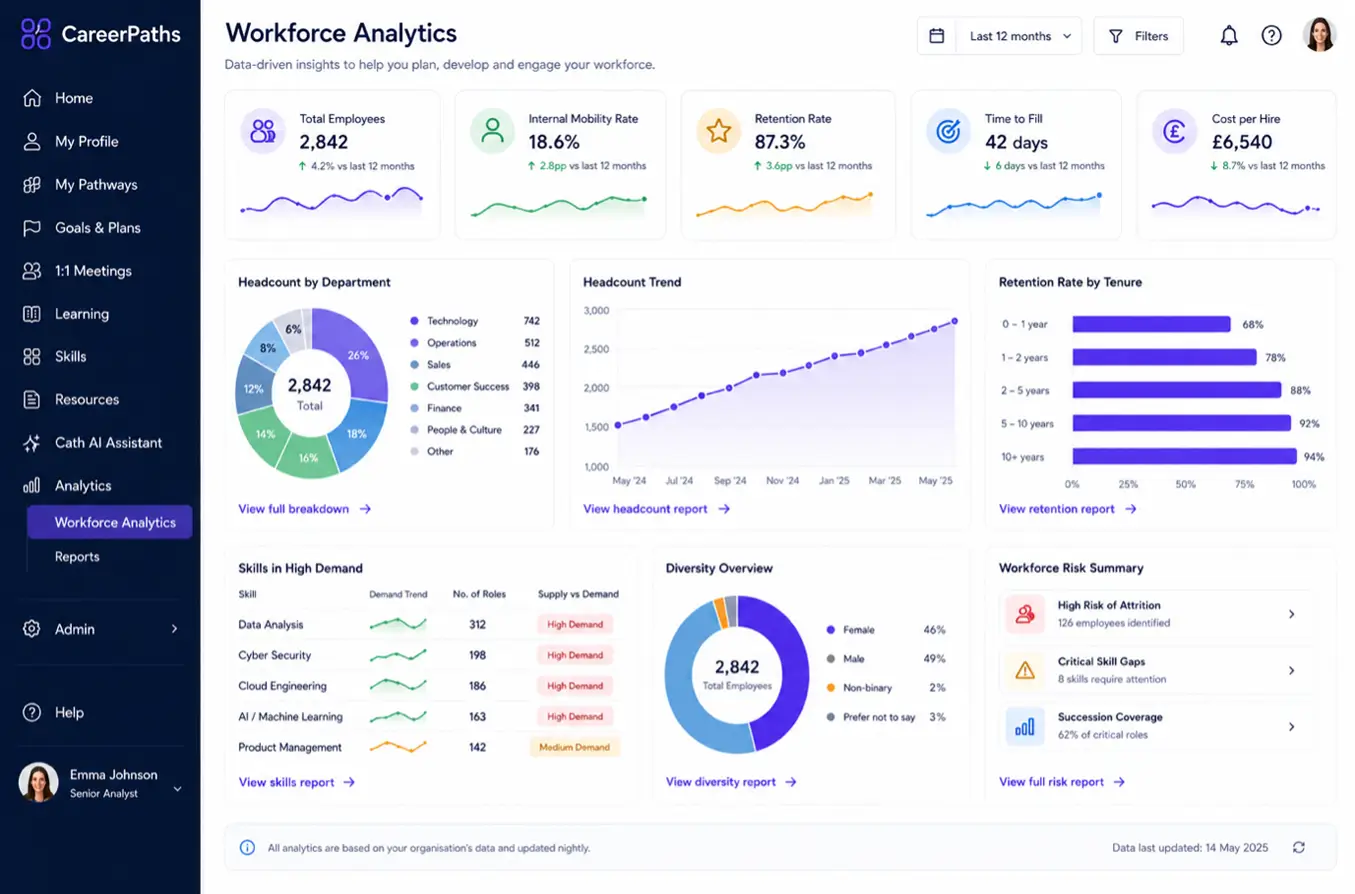
For an individual: this person against the role they're aiming at, with the specific skills, competencies and learning in between. Organisation-wide reporting against strategic goals is on our roadmap.

Our careers assistant, grounded in your roles, pathways and tone of voice — not in a general-purpose chatbot's idea of career advice. Disable it entirely, or run it through your own AI provider account, if that's what your policy needs.
Getting your data in
Your structure, departments, job families and roles come across in a bulk import at setup. Nobody rekeys anything. Your administrators hold it from there.
There's no connector to configure, no pipeline for your security team to review, and no place in your IT team's queue to wait for. Most organisations start with one department or business area, and they can start the week they decide rather than the quarter a systems project frees up.
Which means the thing standing between you and a working career map is a decision, not a deployment.
What connects today
"Integration" covers three quite different things, and they're worth separating, because the answers aren't the same.
- Your structure and roles, loaded without rekeying — today, by bulk import at setup.
- Your people, with accounts — today, by bulk import at setup, managed by your administrators.
- Live vacancies on your careers site — today, including feeds from your existing recruitment system, and multi-employer boards for membership organisations and sector bodies.
- Automatic sync with your HR system — on our roadmap.
- Single sign-on, then automated provisioning — planned for the first release after general availability.
The third point is the one worth pausing on. Live vacancy feeds are the hardest part of that list, and we've been building them for fifteen years — on careers websites for the Scotch Whisky Association, for sector skills bodies, for national membership organisations. It isn't a roadmap item here. It's running today, on sites you can go and look at.

What's coming, and in what order
We publish the order rather than the dates. A date we haven't earned is just a disappointment with a calendar invite attached — and in our experience the sequence is the part that actually affects your planning.
- Enterprise single sign-on comes first. Your people reach CareerPaths with the corporate login they already have, and your identity team keeps control of access where it already manages it. It's first on the list after general availability, because it's the thing raised earliest in almost every security review — and because a careers platform people have to remember a separate password for is a careers platform people stop opening.
- SCIM 2.0 provisioning follows SSO. This is the piece that makes joiners, movers and leavers automatic: accounts created, updated and deactivated by your identity platform, with nobody having to remember. It follows single sign-on rather than arriving alongside it, because that's the order these two are almost always deployed in anyway — SSO establishes the trust relationship, provisioning then rides on it.
- Scheduled sync with your HR system comes after that — structure and role data kept in step without a re-import.
- Organisation-wide reporting against strategic goals - sits alongside the three: capability supply measured against strategic demand across the organisation, rather than one person at a time.
If any of these is a firm requirement rather than something you'd happily pick up as it lands, raise it early in the conversation. We'll tell you exactly where it is — and if the sequencing doesn't suit your timetable, it's better for both of us to know that in week one.
For your IT and security team
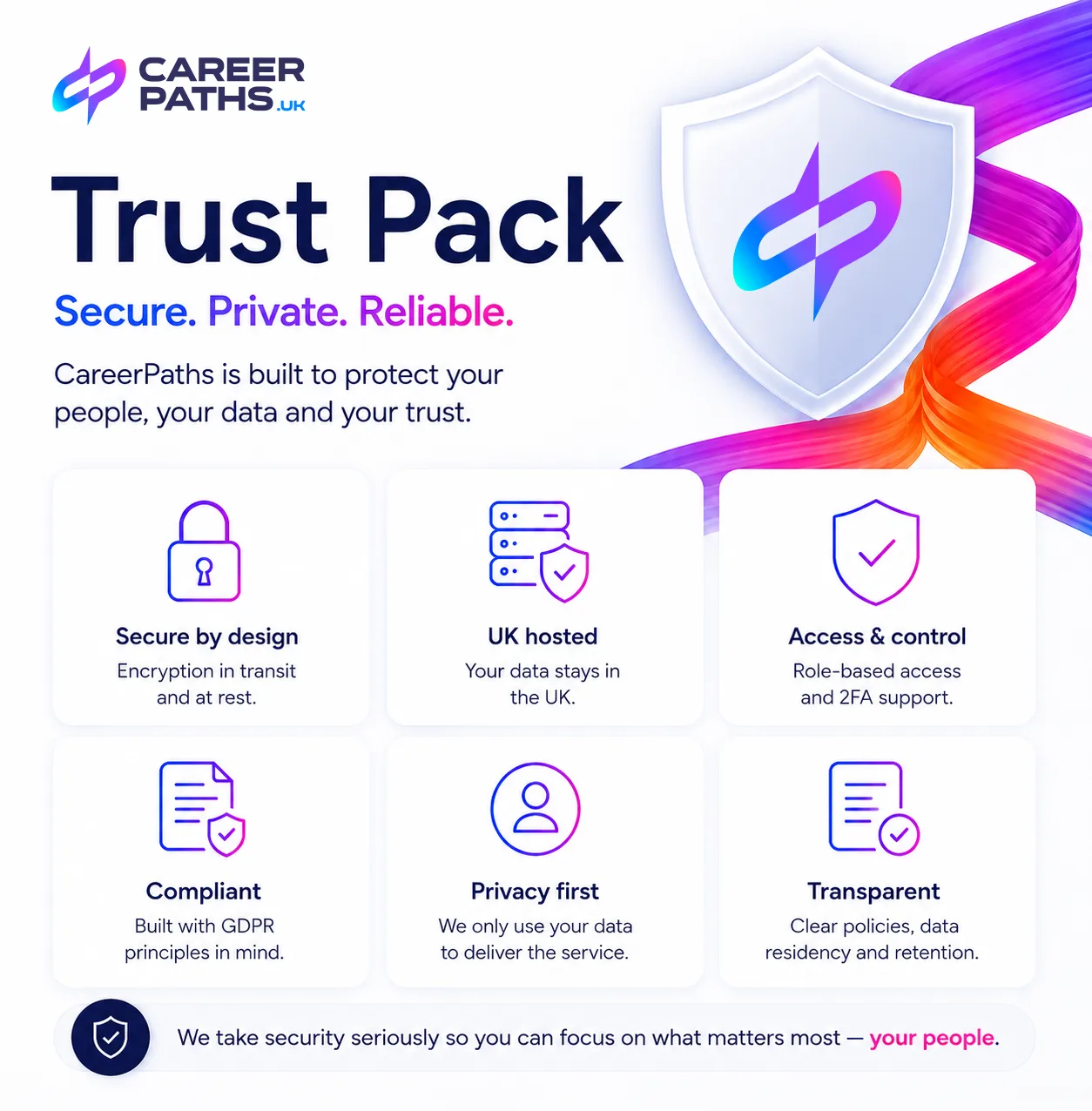
Each organisation runs in its own isolated tenant, separated at the data layer rather than by a filter on a shared database. Encryption in transit and at rest, with field-level encryption on sensitive content, files and private resources. Enforceable two-factor authentication.
Your content is not used to train CareerPaths' models.
And because there's no standing connection to your HR system, there's no live data pipe to assess — which usually makes this the shortest security review on the shortlist.
The full detail — policies, sub-processors, controls, what's built and what isn't — is in our Trust Pack, and you can have it before you commit rather than after you've signed. No sales call, and allow up to 72 hours.
Where organisations usually start
One department or business area, built from what you already have — your structure, your job descriptions, whatever framework exists. The work is turning that into something people can navigate, and it's done with you rather than to you. Nothing is visible to your employees until you've approved it.
The routes through your organisation are almost certainly real. Making them visible is a piece of work you can start this month, and it doesn't need a single line of integration to be worth doing.