

She volunteered for three years. Then took a paid job somewhere else.
She'd learned to run events, handle difficult conversations, manage a rota and train new starters. You had a role that needed exactly those things.
Nobody ever showed her it existed.



You can't outbid anyone. You can out-develop them.
Most employers compete on salary. You largely can't, and you know it. What you have instead is purpose — and purpose brings people in the door, but it doesn't keep them there on its own.
What keeps them is the sense that this is going somewhere. That the skills they're building are real, recognised, and lead to something.
When that isn't visible, people who joined for the mission leave for the career. Usually to a sector that pays more anyway.
Your best future employees are already working for you. For free.
Volunteers develop genuine, transferable capability — and almost no organisation maps it. The route from volunteering to paid employment exists in practice and is invisible on paper.
CareerPaths makes it explicit:
Show what volunteering leads to.
Which paid roles a volunteer is closest to, what those roles require, and what the gap actually is.
Recognise skills people already have.
The competencies someone has built running a shop, leading a group or coordinating a site — named, levelled and visible.
Make it a route, not a rumour.
So a volunteer wondering whether there's a future here can see one, rather than having to ask someone brave enough to answer.
A volunteer who can see a route has a reason to stay that a volunteer who can't doesn't. Volunteers who become employees arrive already knowing the organisation.
We don't charge per volunteer.
The obvious worry with per-seat software is that a few hundred staff and several thousand volunteers becomes unaffordable immediately.
So we don't price it that way.
Volunteers see everything on your careers website. Roles, pathways, what leads where, and how volunteering connects to paid work. No seat, no charge, whatever the number.
And volunteers get free software seats too — the same full access as your paid staff, so they can explore pathways, see what a paid role would need, and hold career conversations with whoever supports them.
How widely you roll that out is entirely your call. It's part of the conversation when we set you up.
Here's exactly how that works:
Free volunteer seats come with paid staff seats. They're an extension of your subscription, not a subscription on their own.
Up to ten free volunteer seats for every paid seat you hold. Fifty paid seats gives you five hundred volunteer seats. Most organisations never come close.
A volunteer is someone who receives no salary from your organisation. We'd rather define it plainly than leave it fuzzy.
You decide who gets a seat, and how far you roll it out. Some organisations open it to every volunteer; others start with a scheme, a region or a cohort and grow from there. You know your volunteers; we don't. If a seat goes unused for ninety days it returns to your pool and you can give it to someone else.
Cath isn't included in free seats. Our AI career guide costs us money for every conversation, and we can't absorb that at no charge. If you'd rather your volunteers had her, connect your own AI provider and licence keys — the platform supports that, and then the seats are yours to use as you like.
Three ways to make careers visible.
A careers website.
Your roles, your pathways, your volunteer routes and your live vacancies — for staff, volunteers, and people who've never heard of you. Branded, hosted and supported by us.
Career Visibility Software.
Structured career conversations, individual gap analysis, and pathways your staff can explore. Built from the roles you already have.
Interactive careers tools.
Quizzes, self-assessments, animated scenes and bespoke tools — for schools work, volunteer recruitment and open days.
Take one, or connect them. They run on the same set of career data, so the work isn't done twice.
Sites, regions, and nobody at head office
If your organisation runs across dozens of sites, career development tends to depend on whether someone's local manager is good at it. Some people get a conversation about their future. Most don't.
Making pathways visible in one place, to everyone, closes that gap — regardless of who they report to or how far they are from head office.
Where we've done this
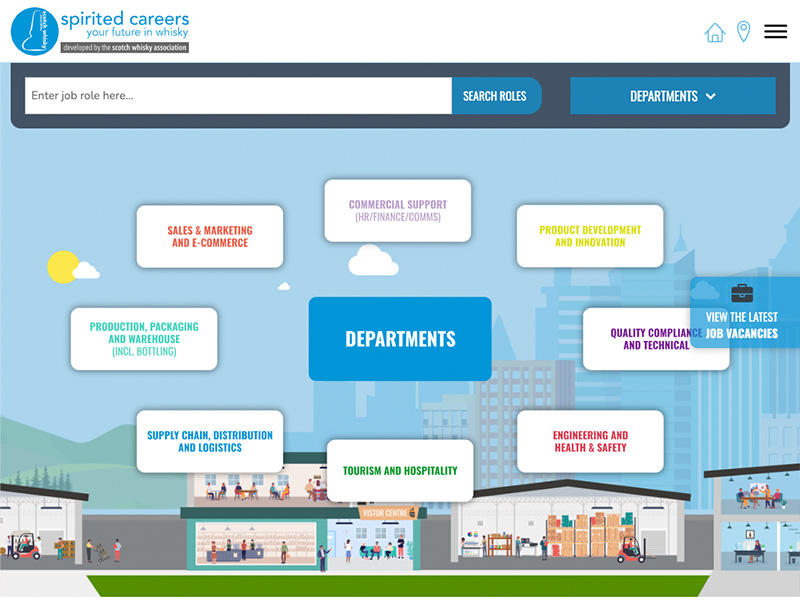
We've built careers websites, sector career maps and job boards for the Scotch Whisky Association, the National Skills Academy for Food & Drink and NHS England, among others.
Not charities — and we'd rather say so than imply otherwise. What those organisations share with you is the harder version of the problem: workforces spread across many employers and sites, roles that are difficult to explain from outside, and audiences who need bringing in rather than filtering.


Straightforward pricing, before the call.
including your first 50 users. No setup fee, no minimum term. Free volunteer seats on top, up to ten for every paid seat.
Half-price setup until 31 December; standard £1,500. Hosting, support and your jobs board included. 24 months minimum term applies.
£450/month if standalone. Bespoke projects scoped and quoted. 24 month minimum term applies.
All prices exclude VAT. Everything is published in full on our pricing page, because you shouldn't have to book a call to find out what something costs — least of all when you're spending money that was donated.
Thirty minutes, and an honest answer about fit.
We'll look at your roles, your volunteers and what you're actually trying to fix. If we're not the right people, we'll say so.